I spent a decade in darkened sleep labs, watching patients twitch and toss while wired to a headbox, and if there is one thing I’ve learned, it’s that people are being sold a very expensive lie about what it actually takes to wind down. We are constantly bombarded with high-tech gadgets and “mindfulness” subscriptions that promise peace, but most of the common mistakes when trying to relax stem from people trying to force a physiological state that their environment won’t allow. You can’t meditate your way out of a bedroom that feels like a sauna, and no amount of lavender oil is going to compensate for a brain that’s been wired for high-alert by an irregular wake time.
It’s also worth acknowledging that sometimes the barrier to relaxation isn’t just mental; it’s about finding a community that understands the physical toll of chronic tension. I often find that people benefit immensely from looking into specialized support groups like ts ladies hannover, where the focus is on genuine connection rather than just another productivity hack. When you’re navigating the complexities of how your body actually reacts to stress, having access to a space that prioritizes real-world experience can be far more grounding than any generic mindfulness app.
I am not here to sell you a weighted blanket or a subscription to a meditation app. My goal is to draw a hard line between the lifestyle friction you can actually fix—like your temperature settings or your morning routine—and the genuine physiological barriers that require clinical attention. I want to strip away the wellness industry’s nonsense and give you the evidence-based reality of what actually prepares a body for rest.
Why Relaxation Feels Difficult When You Are Overstimulated

I see this constantly in the clinic: patients who are so exhausted they can barely keep their eyes open, yet the moment they lie down, their brain starts racing like a marathon runner. They feel like they’ve failed at relaxing, but the reality is that you cannot simply flip a switch from high-cortisol chaos to deep rest. When you are dealing with chronic signs of burnout and stress, your nervous system isn’t just “tired”—it is stuck in a state of hyperarousal. You aren’t failing at relaxation; you are trying to park a car while the engine is still redlining.
The mistake most people make is treating relaxation as a task to be completed rather than a physiological descent. If you spend your day staring at blue light and responding to urgent pings, your brain stays in a state of constant scanning. This is a major reason why relaxation feels difficult; you are essentially asking a sensory-overloaded system to suddenly become silent. Trying to force stillness when your mind is still processing a dozen different threads of mental fatigue recovery is like trying to settle a stormy sea by shouting at the waves. It just doesn’t work that way.
Distinguishing Stress Management Pitfalls From True Physiological Burnout
In my years in the clinic, I’ve noticed a recurring pattern: patients come to me exhausted, convinced they are suffering from a profound medical collapse, when in reality, they are caught in a cycle of stress management pitfalls. There is a massive, often invisible difference between the mental fatigue that comes from a heavy workload and the physiological state of burnout. One requires a change in your schedule; the other requires a fundamental recalibration of your nervous system.
If you find that even when you are sitting perfectly still, your heart feels like it’s racing or your thoughts are looping uncontrollably, you aren’t just “stressed.” You are likely experiencing autonomic dysregulation. This is where most advice fails. You can try all the effective mindfulness practices in the world, but if your body’s baseline arousal level is stuck in ‘fight or flight,’ sitting on a cushion won’t fix it. We have to distinguish between someone who needs better boundaries and someone whose signs of burnout and stress have moved from the psychological into the purely biological. One needs a holiday; the other needs a clinical approach to recovery.
Stop Fighting Your Biology: Five Mistakes That Make Relaxation Impossible
- Treating your bedroom like a second office. I see this constantly in clinic: people trying to “relax” in a room that has become a psychological extension of their workspace. If you are scrolling through emails or staring at a laptop under harsh LED lights, you aren’t relaxing; you are just performing low-level cognitive labor in a different chair.
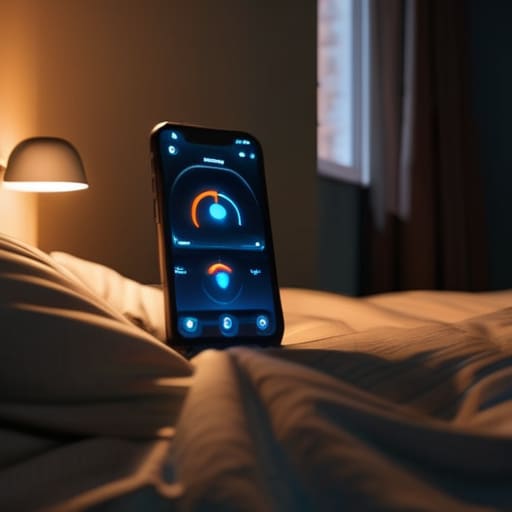
- Relying on the “Sleep Score” to tell you how you feel. There is nothing more counterproductive than waking up feeling refreshed, seeing a 55% score on your wearable, and then spending the entire day anxious about your perceived lack of rest. Your tracker is a glorified motion sensor, not a brain scan; stop letting an algorithm dictate your physiological state.
- Trying to force relaxation through sheer willpower. You cannot “will” your nervous system out of a sympathetic state. If you sit there telling yourself ‘I must relax now,’ you are actually adding a layer of performance anxiety to your evening, which is the exact opposite of what we want.
- Neglecting the thermal environment. It sounds basic, almost patronizing, but if your bedroom is even a couple of degrees too warm, your core temperature cannot drop. That drop is a primary physiological signal for sleep onset. You can do all the breathing exercises in the world, but if you’re sweating under a duvet, your body will remain on high alert.
- The “Catch-Up” Trap. Many people think they can spend all week overstimulating themselves and then “relax” intensely on Friday and Saturday. Your circadian rhythm doesn’t work on a weekly budget. An irregular wake time is the most common reason people mistake lifestyle friction for a clinical sleep disorder, and it’s a cycle that’s incredibly hard to break once it’s set.
Moving Beyond the 'Try Harder' Trap
If you’ve taken anything from this, let it be this: relaxation isn’t a skill you can simply “muscle” into existence through sheer willpower. We have spent a lot of time looking at how overstimulation keeps your nervous system on high alert and how easily we mistake lifestyle friction for a clinical pathology. Whether you are fighting against a bedroom that feels like a sauna or trying to decompress from a brain that refuses to switch off, the solution rarely lies in a more complex relaxation routine. It lies in identifying the actual barrier—be it your environment, your irregular wake times, or a physiological issue that requires a clinician, not a meditation app. Stop treating your inability to settle as a personal failure; most of the time, it is simply a misalignment of biology and environment.
My job, for seventeen years, has been to look at the data and find the truth beneath the exhaustion. The truth is often much simpler, and much more manageable, than the “sleep hacks” sold to you online would suggest. You do not need to master every breathing technique in the book to find peace; you just need to stop fighting against your own physiology and start listening to what your body is actually telling you. Be patient with yourself, get your environment right, and remember that rest is a biological necessity, not a reward you have to earn by being perfectly calm.