I spent a decade in a darkened sleep lab, watching patients struggle through the night while tethered to a headbox, and if there is one thing I’ve learned, it’s that you cannot judge a mattress by how it feels for thirty seconds in a brightly lit showroom. Most salespeople will tell you to “lie down and see how it feels,” but that is a complete reductio ad absurdum. A quick sit-test is useless; it tells you nothing about how your spine will actually align when you’ve drifted into Stage 3 deep sleep at 3:00 AM. If you want to know how to test a mattress before buying, you have to stop treating it like a sofa purchase and start treating it like a piece of medical equipment.
I’m not here to sell you on “cloud-like” foams or marketing jargon that sounds more like a spa menu than sleep science. Instead, I’m going to give you a practical, evidence-based framework for what you actually need to do—from testing edge support to understanding how temperature regulation affects your sleep architecture. I will show you how to cut through the salesperson’s hype so you can find a surface that actually supports your physiology, rather than just one that looks good in a brochure.
Stop Trusting the Showroom Floor How to Test a Mattress Before Buying
The biggest mistake I see is people treating a mattress showroom like a quick pit stop. You might feel like you’ve found “the one” after five minutes of lying on a surface, but five minutes is not a sleep study. In the clinic, we look at how a body behaves over hours of physiological shifts; in a showroom, you’re just testing how your muscles react to a momentary change in pressure. You need to move beyond the polite “it feels okay” and actually simulate your nocturnal reality. This means testing the sleep position impact on mattress support—if you’re a side sleeper, don’t just sit on the edge; lie down in your actual sleeping posture and see if your shoulder is being crushed or your spine is bowing.
Don’t let the salesperson rush you through a checklist of mattress firmness levels without actually feeling the difference between a hybrid vs memory foam feel. One offers bouncy, immediate response, while the other cradles you in a way that can feel like sinking into quicksand. Most importantly, before you hand over your card, hunt down the mattress return policy fine print. A “trial” is meaningless if it doesn’t account for the fact that your body needs at least three weeks to adjust to a new surface.
Why Mattress Firmness Levels Are Often a Marketing Deception
When you walk into a showroom, you’ll see labels everywhere: “Plush,” “Medium-Firm,” “Extra Firm.” It feels scientific, doesn’t it? But as someone who has spent seventeen years looking at the physiological reality of how bodies actually rest, I can tell you that these mattress firmness levels are largely arbitrary. A “medium” to one person is a “rock” to another, depending entirely on your body mass and how your joints settle into the surface. Manufacturers use these vague descriptors because they are safe; they allow a single product to be marketed to everyone, even though no single mattress is actually right for everyone.
The real deception lies in the fact that firmness isn’t a static setting—it’s a relationship between you and the material. This is where the sleep position impact on mattress becomes vital. If you’re a side sleeper, a “firm” mattress might feel like it’s fighting your hips all night, whereas a stomach sleeper might find that same surface perfect. You aren’t just buying a slab of foam; you’re buying how that foam reacts to your specific anatomy. Don’t let a salesperson convince you that a “firm” rating is a universal standard of quality.
The Truth About Hybrid vs Memory Foam Feel and Support
When you’re standing in a showroom, the salesperson will likely try to steer you toward the “latest technology,” which usually means a fancy hybrid or a deep memory foam slab. But from where I sit, looking at how people actually move in their sleep, the hybrid vs memory foam feel is less about luxury and more about how your body manages heat and pressure. Memory foam is wonderful for that “hugged” sensation, but for many of my patients, it becomes a heat trap that disrupts sleep architecture by causing micro-awakenings. Hybrids, with their pocketed springs, offer a more responsive bounce that helps you change positions without feeling like you’re fighting your way out of quicksand.
You also need to consider the sleep position impact on mattress choice. If you’re a side sleeper, you need that pressure relief to prevent your hips from aching by 3:00 AM; if you’re a back sleeper, you need structural integrity to keep your spine neutral. Don’t just lie there for thirty seconds to “test” it. I want you to simulate your actual movement. If the foam feels too stagnant or the springs feel too bouncy for your specific anatomy, no amount of marketing fluff will fix that once you’re home.
Decoding the Sleep Position Impact on Mattress Performance
When you’re lying there in the showroom, don’t just settle for how your back feels in one pose. You need to simulate your actual nightly routine. If you are a side sleeper, you aren’t just looking for softness; you are looking for a surface that allows your shoulders and hips to sink in enough to keep your spine neutral. If you’re a stomach sleeper, too much “give” will cause your lower back to arch painfully by 3:00 AM. The sleep position impact on mattress performance is often what people overlook during those frantic five-minute testing sessions.
I see this constantly in clinic: patients with chronic neck pain who bought a mattress based on how “luxurious” it felt while sitting on the edge, rather than how it supported their alignment during deep sleep. Don’t just test the mattress firmness levels by pressing your palm into the surface. Lie down in your primary position, then switch to your secondary one. If you find yourself tossing and turning in the store because the transition feels awkward, that’s a massive red flag for how you’ll feel after a week in your own bedroom.
Practical in Store Mattress Testing Tips for the Discerning Sleeper
When you finally get permission to lie down, don’t just perform a thirty-second “flop” and call it a day. That is how you end up with a mattress that feels fine in the showroom but becomes a torture device by week three. I want you to simulate your actual nocturnal habits. If you are a side sleeper, lie on your side for at least five minutes to see if your hips sink too deep or if your shoulders feel compressed. You need to observe the sleep position impact on mattress contouring in real-time, not just through the lens of a salesperson’s “it feels supportive” pitch.
Secondly, stop focusing solely on the immediate sensation of the top layer. While the hybrid vs memory foam feel is often what catches your attention initially, you must check for stability. If you shift your weight, does the whole surface oscillate like a trampoline? That’s a red flag for long-term spinal alignment. Finally, before you hand over your card, look past the comfort and interrogate the mattress return policy fine print. A “trial” is meaningless if the fine print excludes you because you didn’t use their specific protector or if the duration is too short to actually adjust to a new sleep architecture.
Avoiding the Trap Mattress Return Policy Fine Print and Trials
Here is where the marketing departments get truly clever. They know that even with the best in-store mattress testing tips, you can’t truly know how a surface interacts with your spine until you’ve spent seven consecutive hours on it. This is why they push “risk-free” trials, but I want you to be wary. A trial isn’t a guarantee; it’s a legal contract disguised as a courtesy. You need to dig into the mattress return policy fine print before you even think about swiping your card. Does “risk-free” mean you get a full refund, or are you looking at a hefty “restocking fee” that effectively costs you hundreds of pounds just for changing your mind?
Furthermore, watch out for the “exchange only” trap. Some companies will happily swap your mattress for another model to try and fix the issues you’re having, but they won’t actually give your money back. If the mattress sleep trial duration is only fourteen days, forget it. In my experience, it takes at least three weeks for your body to stop fighting a new sleep surface and actually settle into a rhythm. If they don’t give you a minimum of thirty days, they aren’t offering a trial; they’re offering a gimmick.
Beyond the eight-second lie: Five ways to actually vet a mattress
- Forget the “sit and bounce.” If you aren’t lying down in your actual sleeping position for at least ten to fifteen minutes, you aren’t testing a mattress; you’re just testing a piece of furniture. You need to see how your spine reacts when the weight is actually distributed, not just how the springs react to your weight when you’re sitting on the edge.
- Test for “motion transfer” by having someone else move near you. I’ve seen far too many people buy a beautiful-looking bed only to realize six months later that every time their partner rolls over, it feels like a minor earthquake. If you’re a light sleeper, this is a non-negotiable physiological requirement, not a luxury.
- Pay attention to the “temperature trap.” Memory foam is notorious for heat retention, and while a salesperson might call it “body contouring,” I call it a recipe for mid-night waking. If you feel an immediate sense of being “cradled” or “trapped” in the showroom, ask yourself if you’re prepared to wake up at 3:00 AM in a sweat.
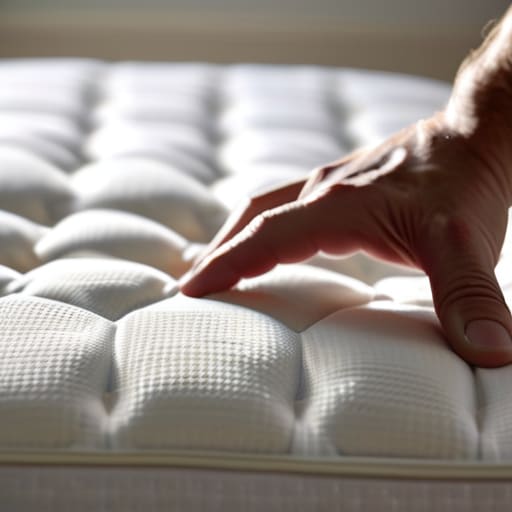
- Check the edge support. It sounds trivial until you find yourself sliding off the bed in the middle of the night. Press your hands firmly against the edge of the mattress; if it collapses immediately under moderate pressure, you’re going to lose a significant amount of usable sleep surface.
- Bring your own “data”—or at least your history. Don’t just tell the salesperson you want “firm”; tell them if you wake up with lower back stiffness or shoulder pain. Use your existing physical symptoms as your guide rather than the marketing terminology on the price tag.
The bottom line before you sign the receipt
Don’t let a five-minute sit on the edge of a bed fool you; if you can’t spend at least fifteen minutes in your actual sleeping position, you aren’t testing a mattress, you’re just testing a chair.
Ignore the “firmness scale” printed on the side of the box—it’s a marketing tool, not a clinical measurement, and it won’t tell you how your spine will actually feel at 3:00 AM.
Prioritise the trial period over the showroom experience; the only way to know if a mattress works is to see how it handles your body after a full night of movement, not just a few minutes of stillness.
Frequently Asked Questions
If I can't spend a full night on the mattress in the showroom, how do I know if it will actually support my spine by 3:00 AM?
You can’t, and that’s the uncomfortable truth. A showroom is a controlled environment; it’s bright, you’re alert, and you’re only lying there for minutes. By 3:00 AM, your body temperature has dropped, your muscles have finally surrendered their daytime tension, and you’ve likely shifted positions five times. This is exactly why I tell my patients to ignore the “feel” of a mattress in a shop and prioritise a generous, no-questions-asked home trial.
My wearable tracker says I sleep poorly on firm surfaces, but the salesperson insists I need one for back pain—who should I actually believe?
Trust the salesperson’s intent, but ignore their “prescription.” They are selling a product, not a clinical diagnosis. Your wearable, however, is also guessing; it’s measuring movement, not spinal alignment or actual restorative sleep. If your tracker shows poor sleep on firm surfaces, it’s likely a sign of pressure point discomfort disrupting your sleep architecture. Don’t buy a firm mattress just because you have back pain; buy the one that allows you to stay still and undisturbed.
Is it possible that my "bad" mattress isn't the problem, but rather my bedroom temperature or irregular wake times are sabotaging my sleep regardless of what I lie on?
It’s entirely possible—in fact, it’s more common than you’d think. I see it in the clinic constantly. You can buy the most expensive, scientifically engineered mattress on the market, but if your bedroom is a sauna or your wake-up time shifts by two hours every day, your circadian rhythm is in chaos. A mattress provides support, but it doesn’t regulate your biology. Don’t spend a fortune on foam if your thermostat is the real culprit.