I spent a decade in the dark, watching patients twitch and toss while wired to a headbox, so I know exactly what a “bad night” looks like from a clinical perspective. Most travel blogs will tell you that you need a specific silk eye mask or a portable white noise machine to master how to sleep away from home, but they are selling you expensive distractions. The truth is, your smartwatch’s “sleep score” will likely plummet the moment you enter a hotel room, and that’s not because your physiology has failed you; it’s because you’re obsessing over a meaningless metric instead of managing your environment.
I am not here to sell you on a better pillow or a new wellness gadget. Instead, I want to give you a realistic, evidence-based toolkit for navigating unfamiliar beds without losing your mind. I will show you how to differentiate between genuine travel-induced insomnia and the simple physiological friction of a room that is too warm or a wake-up time that has drifted. We are going to focus on stabilising your circadian signals and managing your environment, because that is what actually works when the lights go out in a strange place.
Understanding How to Sleep Away From Home
When you check into a hotel, your brain isn’t just “tired”; it’s on high alert. In my years in the clinic, I’ve seen how the brain’s evolutionary drive to monitor our surroundings can sabotage a night’s rest. This is what we call overcoming the first-night effect, a physiological phenomenon where one hemisphere of your brain stays slightly more vigilant than the other when you’re in an unfamiliar environment. It isn’t a failure of your willpower or a sign that you have chronic insomnia; it is simply your biology trying to keep you safe in a new place.
Rather than spiraling into a search for portable sleep aids for travelers—which are often just glorified placebos—I suggest focusing on environmental control. If you are struggling with sleeping in hotels for anxiety, the goal is to reduce sensory novelty. Bring your own pillowcase to provide a familiar scent, or use a white noise app to mask the unpredictable sounds of corridors and elevators. We cannot control the architecture of a hotel room, but we can manipulate the sensory input to tell your nervous system that the “threat” level has dropped.
Key Things to Know
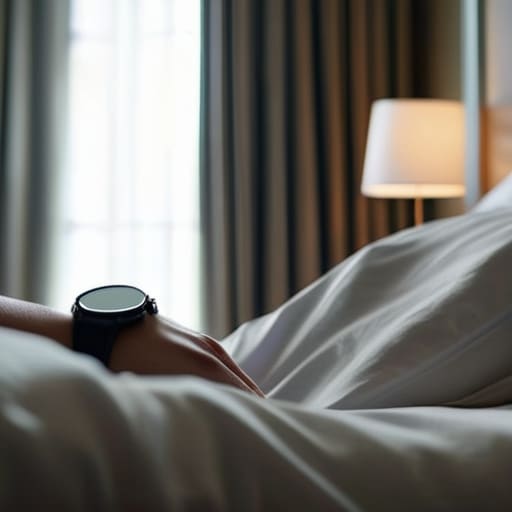
First, let’s clear up a bit of physiological reality: your brain is designed to be suspicious of new environments. In the clinical world, we talk about the “first night effect,” where one hemisphere of your brain stays more vigilant than the other when you’re in an unfamiliar setting. This isn’t a failure of your willpower; it’s an ancient survival mechanism. If you find yourself tossing and turning in a hotel, stop checking your smartwatch to see if you hit “Stage 4 REM.” Your tracker is just guessing based on movement, and seeing a low score will only spike your cortisol and make the problem worse.
Instead of chasing metrics, focus on maintaining your sleep schedule while traveling as much as humanly possible. Your circadian rhythm doesn’t care about your itinerary; it cares about consistency. If you usually wake at 7:00 AM, try to keep that anchor point, even if you arrived late. If you struggle with sleeping in hotels for anxiety, I find that bringing a familiar scent—like a pillowcase from home—can do more to signal safety to your nervous system than any expensive portable sleep aid ever could.
Practical Tips and Steps
First, let’s talk about the environment. If you are staying in a hotel, the temptation is to lean on your wearable to tell you how you slept, but please, ignore that number. Instead, focus on your physical surroundings. I always tell my patients that temperature is the most underrated variable in sleep architecture. Most hotel rooms are kept far too warm; try to dial the thermostat down to about 18°C before you even think about getting into bed. If you find yourself struggling with sleeping in hotels for anxiety, try to recreate a sensory anchor from home—a specific pillowcase or even a familiar scent. It sounds trivial, but it helps signal to your nervous system that the environment is no longer a threat.
Secondly, consistency is your best defense against the “first night effect,” that physiological phenomenon where one hemisphere of your brain stays slightly more alert in a new place. To mitigate this, prioritize maintaining your sleep schedule while traveling over trying to “catch up” on rest. If you usually wake up at 7:00 AM, don’t let a late checkout lure you into a 10:00 AM lie-in. Keeping your wake-up time anchored helps regulate your circadian rhythm, making the transition back to your own bed much less jarring.
Common Mistakes to Avoid
The first mistake I see—and I see it in my clinic all the time—is the desperate attempt to “fix” a bad night by overcompensating the next day. If you struggle with sleeping in hotels for anxiety, your instinct might be to nap for three hours in the afternoon to “catch up.” Please, don’t. You are simply teaching your brain that daytime napping is an option, which effectively sabotages your sleep pressure for the following night. Instead of trying to force sleep, focus on maintaining your sleep schedule while traveling as much as the circumstances allow. Consistency is a far more powerful tool than any amount of caffeine or afternoon shut-eye.
The second trap is a heavy reliance on technology to validate your exhaustion. I cannot stress this enough: your smartwatch is not a medical-grade polysomnograph. When you wake up in a strange room feeling unsettled, checking a low “sleep score” on your wrist only serves to spike your cortisol and trigger more hyperarousal. You aren’t “failing” at sleep because an algorithm says so. Instead of obsessing over metrics, focus on overcoming first night effect by creating a sensory environment that feels familiar, rather than trying to quantify your restlessness.
Final Thoughts
Ultimately, navigating sleep in unfamiliar territory isn’t about finding a magic pill or a perfect piece of technology; it’s about managing the friction between your biology and your environment. Whether you are dealing with the physiological reality of overcoming first night effect or simply trying to manage the mental noise of a new setting, remember that your body is remarkably resilient if you give it the right cues. Don’t let a low score on a wearable convince you that you’ve “failed” at sleeping; those metrics are often just reacting to the novelty of your surroundings.
If you find yourself struggling, focus on the fundamentals: keep your room cool, stick to your usual wake-up time, and try to replicate your home environment as closely as possible. While travel sleep hygiene tips like avoiding late-night caffeine are helpful, the most effective tool you have is consistency. If you can maintain a predictable rhythm, even in a strange place, you take the guesswork out of your rest. Be kind to yourself—sometimes, a slightly disrupted night is just part of the journey, not a sign of a broken system.
My non-negotiables for a decent night in an unfamiliar bed
- Stop checking your wearable’s data the moment you wake up in a new place; if your watch tells you that you had “poor” sleep, you’ve already lost the battle against perceived exhaustion before your day has even begun.
- Prioritise your wake-up time over your bedtime; even if you’re staying up late for a dinner or an event, try to get up at your usual hour to keep your circadian rhythm from drifting into total chaos.
- Audit the thermostat immediately; hotel rooms are notorious for being kept too warm, and since a rise in core body temperature is a physiological signal to wake up, you’ll likely find yourself tossing and turning in a stuffy room.
- Create a “sensory anchor” by bringing one familiar item from home—a specific pillowcase or even just the scent of your own hand cream—to signal to your nervous system that it is actually safe to power down.
- Treat the “first night effect” as a biological reality rather than a personal failure; your brain is wired to stay hyper-vigilant in new environments, so if you don’t sleep deeply, don’t panic—it’s just your biology doing its job.
The Essentials for a Restful Night Away
Ignore your wearable’s “sleep score” if you wake up feeling groggy; travel-induced disruptions are real, and a gadget’s interpretation of your data won’t tell you much when your circadian rhythm is being nudged by a new environment.
Prioritize your wake-up time over your bedtime; even if you struggle to fall asleep in a strange hotel room, getting up at your usual time is the most effective way to keep your internal clock from drifting.
Control your environment where you can, specifically temperature; a room that is too warm is a common culprit for poor sleep, so don’t be afraid to crank the AC or open a window to ensure the space stays cool.
Frequently Asked Questions
My wearable says my sleep quality was terrible because I woke up in a different bed; should I actually be worried about my data?
Please, put the watch in a drawer and breathe. Your wearable isn’t measuring your sleep; it’s measuring your movement and heart rate variability, both of which spike when you’re in an unfamiliar environment. A different mattress and a new room trigger a subtle physiological alertness—we call it the “first-night effect.” Your tracker sees this disruption and calls it “poor quality,” but it’s actually just your brain doing its job. The data is noise, not a diagnosis.
Is there a way to tell if my restlessness in a hotel is just travel anxiety or if I’m actually experiencing a disruption in my sleep architecture?
It’s a fair question, and honestly, one I hear a lot when people look at their confusing data. Here is the truth: your tracker cannot see your sleep architecture; it’s just guessing based on movement. If you feel “wired” or your mind is racing about your itinerary, that’s likely anxiety. But if you wake up gasping or feel physically exhausted despite “sleeping” eight hours, we might be looking at something more clinical.
How much does a change in room temperature during travel actually impact my ability to reach deep sleep stages?
It’s significant. To reach those restorative deep sleep stages, your core body temperature needs to drop. When you’re traveling, you often lose control over the thermostat, and a room that’s too warm acts like a physical barrier to that cooling process. If your body is struggling to shed heat, your brain stays in a lighter, more fragmented state. It isn’t just “uncomfortable”—it is a physiological hurdle to the quality of sleep you actually need.