I spent a decade in the dark, sitting in clinical observation rooms while patients lay wired to headboxes, their breathing patterns telling stories their brains couldn’t even process. I’ve seen the exhausted faces of nurses and emergency responders who have been told by every “wellness influencer” that they just need a better blackout curtain or a more expensive magnesium supplement. It’s infuriating. Most of the advice you find when searching for a complete guide to shift work sleep is just a collection of expensive, shiny distractions that ignore the actual physiological battle your circadian rhythm is fighting. You don’t need a subscription-based sleep tracker to tell you that you’re tired; you need to understand why your body is struggling to exist in a world that wasn’t built for your schedule.
In this guide, I am stripping away the fluff and the pseudo-science. I’m going to help you distinguish between simple lifestyle adjustments and the genuine, heavy-duty physiological disruptions that require a more clinical approach. We aren’t going to talk about “sleep hacks”; we are going to talk about evidence-based strategies for managing your biology. My promise is simple: no hype, no useless gadgets, just the honest truth about how to navigate the chaos of shift work without losing your mind.
The Myth of the Broken Clock a Complete Guide to Shift Work Sleep
The problem with most advice for shift workers is that it treats your body like a machine that just needs better maintenance, rather than a biological system governed by an uncompromising internal clock. When you rotate between nights and days, you aren’t just “tired”; you are experiencing profound circadian rhythm disruption. Your brain is receiving conflicting signals: your eyes see the morning sun, telling your system to wake, while your body is screaming for the restorative stages of deep sleep that usually only happen under the cover of darkness.
This isn’t something you can simply “willpower” your way through with more caffeine. I often see patients who have tried every bit of sleep hygiene for night shifts suggested by influencers, only to find themselves staring at the ceiling at 10:00 AM, feeling utterly defeated. They aren’t failing at sleep; their biology is simply working against their schedule. To manage this, we have to move beyond basic tips and look at how to anchor your physiology—using tools like heavy-duty blackout curtains for daytime sleep to trick the pineal gland, and being much more surgical about when you actually allow yourself to rest.
Circadian Rhythm Disruption When Your Body Forgets the Sun

The problem isn’t just that you’re tired; it’s that your internal master clock is essentially being gaslit by your schedule. Your body is biologically programmed to expect light to signal alertness and darkness to trigger the release of hormones that prepare you for rest. When you flip that script, you aren’t just fighting sleepiness—you are experiencing profound circadian rhythm disruption. Your brain is receiving conflicting signals: your eyes see the morning sun, but your internal chemistry is screaming that it’s midnight. This mismatch is why you can feel “tired but wired,” a state where your body is physically exhausted but your neurological systems are stuck in a state of high alert.
In the clinic, I see people trying to fix this with a frantic checklist of “hacks,” but you cannot simply willpower your way out of a physiological mismatch. While some people find success with melatonin for shift workers to help signal the brain that the “day” has begun, it isn’t a magic bullet for a broken cycle. You have to stop treating sleep as a luxury you fit in between shifts and start treating it as a biological requirement that needs a dedicated, artificial environment.
Beyond Blackout Curtains Why Your Bedroom Environment Fails You
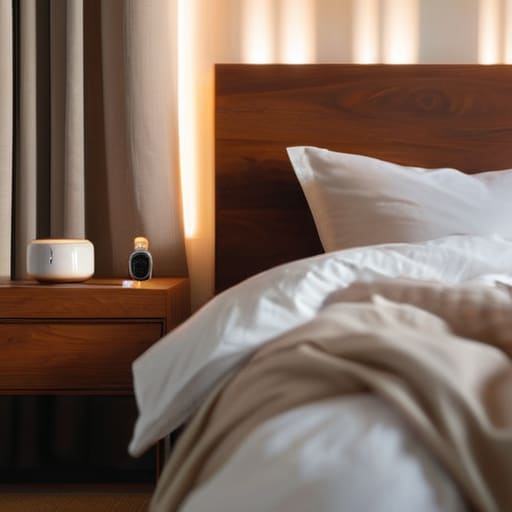
I see it every week in the clinic: patients who have spent a small fortune on the latest “sleep tech” and heavy-duty blackout curtains, yet they still wake up feeling like they’ve been hit by a lorry. The problem is that we tend to treat the bedroom like a sensory deprivation tank, when we should be treating it like a physiological recovery zone. While blackout curtains for daytime sleep are a non-negotiable starting point, they only address the light. They don’t address the fact that your core body temperature is naturally programmed to rise when you are trying to sleep at 10:00 AM. If your room is even slightly too warm, your brain simply won’t transition into deep sleep, no matter how dark it is.
We also need to talk about the “invisible” disruptors. It isn’t just about the light coming through the window; it’s about the biological noise you bring into the room. This includes the heavy meal you ate right before lying down or the blue light from your phone that tells your brain the sun is rising. Effective sleep hygiene for night shifts requires more than just a dark room; it requires managing your internal chemistry so that your environment actually supports your biology rather than fighting against it.
The Melatonin Trap Is Supplementation Actually Helping You
I see it every week in the clinic: a patient, exhausted and desperate, presenting a handful of melatonin supplements like they’re a magic wand. There is a massive misconception that melatonin is a sedative—a “sleep pill” that will knock you out regardless of what time the sun is hitting your window. It isn’t. Melatonin is a hormone that signals to your brain that it is dark; it is a timing signal, not a hammer. If you are trying to use melatonin for shift workers to force sleep during a bright, noisy morning, you aren’t fixing the problem; you’re just shouting at a biological system that isn’t listening.
The danger lies in the timing. If you take it haphazardly to combat circadian rhythm disruption, you can actually end up further desynchronising your internal clock, making the subsequent shift even harder to navigate. It is far more effective to view supplementation as a tool for shifting your rhythm, rather than a way to bypass it. Before you reach for the bottle, we need to look at whether you’ve actually addressed the basics—like your light exposure and your temperature—because a pill cannot compensate for a fundamental mismatch between your biology and your schedule.
Napping Strategies for Shift Workers Strategic Rest vs Constant Fatigue
I see this constantly in the clinic: patients who are exhausted, so they try to “catch up” by napping for three hours every afternoon. This is a mistake. If you are napping for long stretches during the day, you are effectively sabotaging your ability to build enough sleep pressure for your main rest period. You end up in a cycle of perpetual grogginess, never quite reaching deep, restorative stages because your body is perpetually confused.
The goal of napping strategies for shift workers isn’t to replace sleep, but to bridge the gap. If you must nap, keep it to a “power nap” of twenty minutes—just enough to take the edge off the cognitive fog without sliding into a heavy sleep cycle that leaves you feeling like you’ve been hit by a bus when you wake up. If you are managing fatigue during rotation, try to time these naps just before your shift begins rather than in the middle of your “day.” It’s about strategic intervention, not using sleep as a constant, fragmented crutch.
Managing Fatigue During Rotation Separating Bad Habits From Real Disorder
When you’re rotating between days and nights, the exhaustion feels heavy, almost physical. I see this constantly in the clinic: patients who are convinced they have a permanent neurological deficit because they can barely function by 3:00 PM. The difficulty lies in managing fatigue during rotation without falling into the trap of “trying harder.” If your fatigue is driven by a chaotic schedule where you’re trying to compensate for poor sleep with excessive caffeine or erratic meal times, we’re looking at a behavioral struggle. You aren’t broken; you’re just out of sync.
However, there is a line where it stops being about lifestyle and starts being about pathology. If you have implemented strict sleep hygiene for night shifts—meaning you have the blackout curtains, the cool room, and a consistent wind-down routine—and you are still experiencing profound, midday cognitive collapses, we need to talk about more than just habits. We need to look at whether your rotation is masking an underlying sleep apnea or a primary circadian rhythm disorder. One requires a change in routine; the other requires clinical intervention.
Practical Tactics for When Your Schedule Defies Biology
- Stop chasing the “perfect” sleep window. If you’re rotating shifts, your body isn’t going to settle into a neat 10 PM to 6 AM rhythm, so stop punishing yourself for not hitting those marks. Focus instead on the consistency of your anchor sleep—the core block of hours you can protect regardless of the shift.
- Treat your commute like a clinical transition. If you’ve just finished a night shift, wear high-quality sunglasses on the drive home. Flooding your retinas with morning sunlight tells your brain the day has started, making it twice as hard to trick your physiology into sleep once you actually get through your front door.
- Use light as a tool, not a constant. Bright, cool-toned light is your best friend during the first half of a night shift to keep alertness up, but you need to aggressively dim the lights and avoid blue light in the final two hours of your shift. It’s about signaling to your brain that the “sun” is setting, even if it’s actually 7 AM.
- Be wary of the caffeine tail. I see so many people trying to power through the 4 AM slump with a massive coffee, only to wonder why they can’t sleep at 9 AM. If you use caffeine, front-load it. Once you hit the halfway point of your shift, the caffeine should be finished so it isn’t still circulating when you’re trying to crash.
- Ditch the “sleep score” anxiety. If you’re wearing a tracker, stop checking it the moment you wake up. For shift workers, these devices often struggle to interpret the fragmented sleep patterns common in irregular schedules, and seeing a “poor” score will only trigger the very cortisol spike that keeps you from resting well the next time.
The Bottom Line for Shift Workers
Stop treating every bout of fatigue as a medical mystery; often, it’s a predictable physiological response to an irregular wake time and a bedroom that is far too warm to allow for deep, restorative sleep.
Ditch the obsession with your wearable’s “sleep score”—those gadgets are not clinical sleep studies, and they cannot tell the difference between you being still and you actually being asleep.
Learn to distinguish between “lifestyle insomnia” caused by poor scheduling and a genuine clinical disorder, because the advice for one will only frustrate you if you actually need the other.
Frequently Asked Questions
If my wearable says I'm getting "poor quality" sleep during my night shifts, should I be worried about a clinical disorder or is it just reacting to my schedule?
First, take a deep breath and put the watch in a drawer for a second. Your wearable isn’t measuring your brain waves; it’s guessing based on movement and heart rate, and it has no idea you’re working against your biology. A “poor sleep score” during a night shift is almost a mathematical certainty, not a medical diagnosis. Don’t mistake a predictable reaction to a disrupted schedule for a clinical disorder. We look for patterns of physiological distress, not app notifications.
How can I tell if my exhaustion is just a result of my irregular hours or if I've actually developed something like sleep apnea from the constant disruption?
It’s a vital distinction. If your exhaustion lifts after a consistent block of days off, you’re likely just battling circadian misalignment. But if you’re waking up gasping, experiencing morning headaches, or finding yourself snoring heavily despite being “rested,” that’s different. Shift work can mask or exacerbate issues like sleep apnea. Don’t rely on a wearable’s “sleep score” to tell you; if you feel like you’re fighting for air, you need a clinical study, not a new app.
Is there any point in trying to "fix" my sleep hygiene if my body is fundamentally fighting against the sun, or am I just wasting my time with things that won't work?
It’s not a waste of time, but you have to stop treating “sleep hygiene” like a magic wand. If your circadian rhythm is fundamentally misaligned with the sun, a lavender pillow spray won’t fix it. However, poor hygiene acts like friction; it makes an already difficult situation much worse. You can’t force your biology to flip, but you can stop fighting yourself by cooling the room and stabilizing your wake time. Fix the environment to support the biology.